
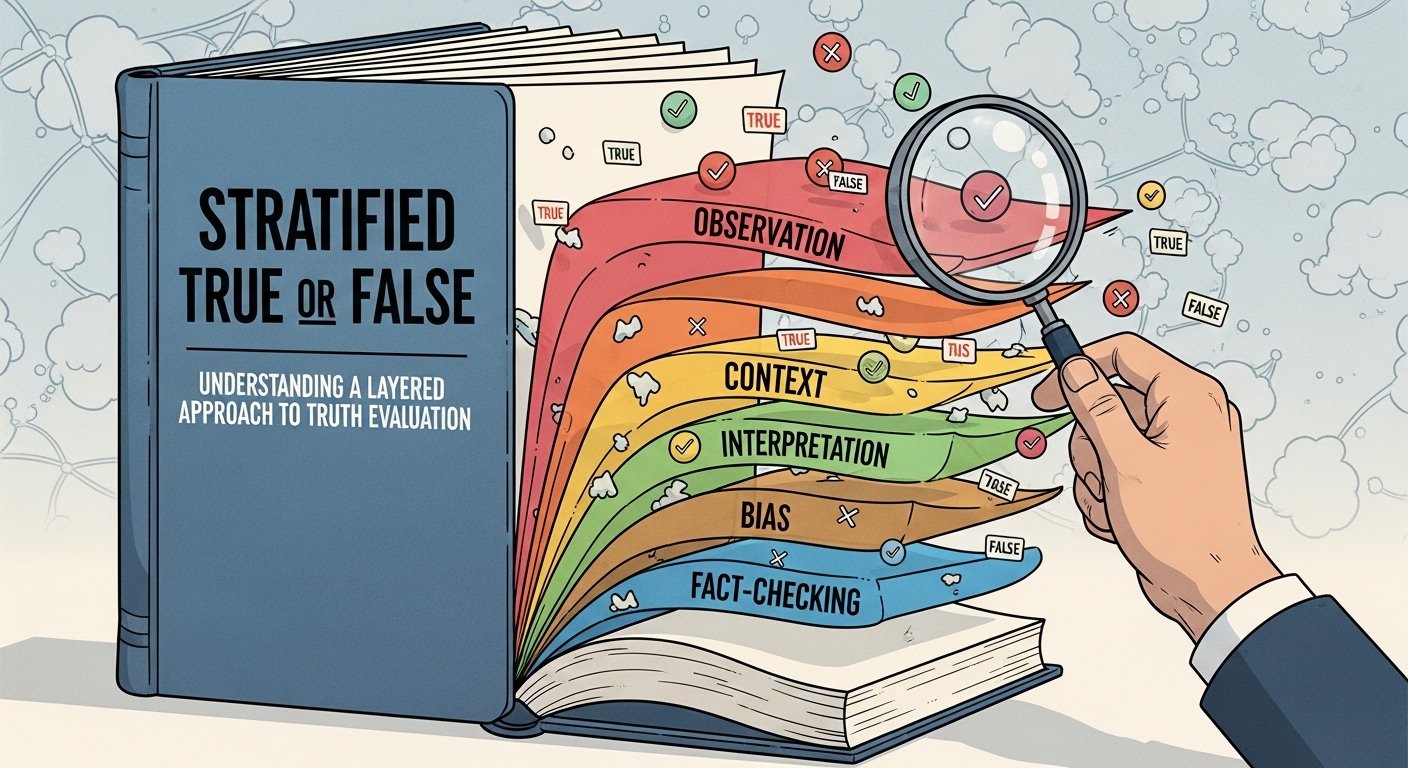
In education, research, and data analysis, evaluating whether a statement is true or false is often more complex than it first appears. Many real-world situations contain multiple layers of information, context, and evidence. This is where the concept of stratified true or false becomes useful. Rather than treating truth as a simple binary choice, stratification examines statements across different layers or categories before reaching a final conclusion.
The idea is widely used in fields such as statistics, data science, surveys, testing systems, and logical reasoning. By dividing information into structured groups—known as strata—analysts can evaluate truth more accurately and avoid misleading results.
This article explores the meaning of stratified true or false, how it works, where it is used, and why it plays an important role in modern data interpretation.
What Does Stratified True or False Mean?
Stratified true or false refers to a method of determining whether a statement is correct by evaluating it within different layers, categories, or groups rather than analyzing the data as a whole.
In a traditional true-or-false evaluation, a statement is judged based on overall information. However, stratification introduces segmentation. Data or evidence is divided into meaningful groups, and the statement is examined within each group separately.
For example, imagine evaluating the statement:
“Students who study online perform better than those who study in classrooms.”
A simple true-or-false approach might look at the overall average performance of both groups. But a stratified evaluation would analyze results by different categories, such as:
-
Age groups
-
Education levels
-
Subject areas
-
Geographic regions
Within each stratum, the answer might differ. Some groups may support the statement, while others may contradict it.
The Concept of Stratification
Stratification means dividing a dataset or population into subgroups that share similar characteristics. These subgroups are called strata.
The goal of stratification is to reduce bias and improve the accuracy of analysis. When data is grouped properly, patterns that might be hidden in overall averages become clearer.
Common stratification variables include:
-
Age
-
Gender
-
Income level
-
Education level
-
Location
-
Time period
By analyzing each layer separately, researchers gain a deeper understanding of whether a statement is truly accurate.
Why Simple True or False Can Be Misleading
Many conclusions become misleading when data is analyzed only at the surface level. A statement might appear true overall but false when examined within specific groups.
This phenomenon often occurs in statistics and decision-making because different groups behave differently.
For instance, suppose a hospital reports that Treatment A is more effective than Treatment B. At first glance, the statement may appear true based on overall success rates. However, after stratifying patients by age or severity of illness, researchers might find:
-
Treatment A works better for younger patients.
-
Treatment B works better for older patients.
In this case, the statement “Treatment A is more effective” becomes conditionally true, depending on the stratum being analyzed.
Stratified evaluation prevents incorrect generalizations.
Stratified True or False in Education
Educational testing often uses stratified true-or-false methods to evaluate student knowledge more accurately.
In simple quizzes, students answer statements with “true” or “false.” However, advanced assessments sometimes evaluate responses within different knowledge categories, such as:
-
Conceptual understanding
-
Practical application
-
Theoretical knowledge
For example, a science question might be:
“All metals conduct electricity.”
At a basic level, students might answer true because many metals conduct electricity. However, a stratified evaluation would consider exceptions and deeper understanding. Students who recognize the nuance might identify that the statement is not universally true.
By evaluating answers through layered reasoning, teachers can assess critical thinking instead of memorization.
Role in Statistical Analysis
Stratified true-or-false reasoning plays an important role in statistics. When analysts interpret research findings, they often divide populations into strata to verify whether conclusions remain valid across groups.
This method helps prevent statistical distortions such as confounding variables or misleading averages.
For example, a study may conclude that:
“People who exercise daily have better health outcomes.”
If the data is stratified by age, analysts might discover:
-
Strong positive effects in middle-aged adults
-
Moderate effects in younger adults
-
Limited effects in elderly populations
The statement remains broadly true, but its strength varies across strata.
Such analysis improves the reliability of conclusions.
Applications in Data Science
In data science and machine learning, stratified true-or-false evaluations are used to validate models and predictions.
When building predictive models, datasets are often divided into stratified samples. This ensures that each category within the data is properly represented.
For example, in medical prediction systems, data might be stratified by:
-
Gender
-
Age group
-
Medical history
-
Lifestyle factors
If a predictive statement such as “The model correctly predicts disease risk” is evaluated without stratification, the results may appear strong overall but weak for certain groups.
Stratified validation ensures fairness and accuracy across all segments.
Stratified True or False in Surveys
Survey research also benefits from stratified analysis. When public opinion is measured, responses are often segmented into groups.
For instance, consider the statement:
“Most people support the new environmental policy.”
Survey results might show overall support of 55%. However, after stratifying responses by demographics, the picture could change:
-
Urban residents: 70% support
-
Rural residents: 40% support
-
Younger voters: 65% support
-
Older voters: 45% support
The statement is technically true overall, but stratified analysis reveals important differences.
This information helps policymakers understand how opinions vary across society.
Advantages of Stratified Evaluation
Stratified true-or-false analysis offers several benefits that improve decision-making and research quality.
Improved Accuracy
Breaking data into layers allows researchers to detect patterns that overall averages may hide.
Reduced Bias
Stratification minimizes the risk that dominant groups will skew results.
Better Insights
Analyzing separate strata provides a deeper understanding of how different populations behave.
Stronger Conclusions
When a statement remains true across multiple strata, confidence in the result increases.
These advantages make stratified evaluation a valuable tool across many disciplines.
Limitations and Challenges
Although stratified true-or-false methods offer many advantages, they also come with challenges.
Data Complexity
Stratifying data increases the complexity of analysis and requires more detailed datasets.
Small Sample Sizes
Some strata may contain very few observations, making conclusions less reliable.
Interpretation Difficulties
When results differ across strata, it can be difficult to summarize the overall conclusion.
Time and Resource Requirements
Conducting stratified analysis often requires additional time, computational resources, and expertise.
Despite these challenges, the benefits often outweigh the limitations in research and data interpretation.
Real-World Example of Stratified Truth
A classic example of stratified evaluation occurs in college admissions data analysis.
Suppose statistics show that one department accepts a higher percentage of applicants than another. At first glance, the statement might suggest bias.
However, when data is stratified by department, it might reveal that:
-
Certain departments receive far more competitive applications.
-
Acceptance rates differ naturally across disciplines.
This layered perspective provides a clearer picture and prevents misleading conclusions.
Conclusion
Stratified true or false represents a more thoughtful and structured way of evaluating statements. Instead of relying on simple binary judgments, this approach examines information across multiple layers or groups.
By dividing data into meaningful strata, analysts, researchers, educators, and policymakers can better understand whether a statement truly holds across different contexts. The method helps reveal hidden patterns, reduce bias, and strengthen the reliability of conclusions.
As data-driven decision-making becomes increasingly important in modern society, stratified evaluation methods will continue to play a crucial role in ensuring that truth is not oversimplified. Instead, truth is analyzed carefully—layer by layer—leading to deeper insight and more informed choices.